



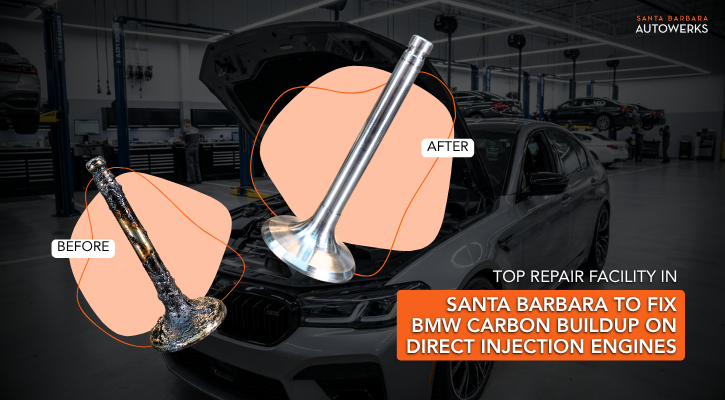
Top Repair Facility in Santa Barbara To Fix BMW Carbon Buildup on Direct Injection Engines
12 May, 26
One of the most common — and most frequently overlooked — maintenance issues affecting modern BMWs is carbon buildup on the intake valves. Unlike older port-injection engines, where fuel spray continuously washed the valve surfaces clean, BMW’s direct injection engines (including the widely used N54, N55, N20, and S55 engines) inject fuel directly into the combustion chamber, bypassing the intake valves entirely. Over time, oil vapor from the PCV system coats the back of the intake valves with a sticky residue that hardens into thick carbon deposits. At Santa Barbara Autowerks in Santa Barbara, California, our BMW specialists perform carbon induction cleaning using the most effective methods available to restore your engine’s performance and efficiency.
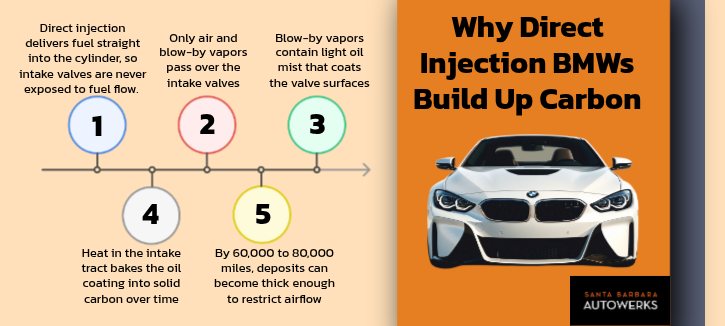
Why Direct Injection BMWs Build Up Carbon
In a traditional port injection engine, fuel spray regularly wets the back of the intake valves and dissolves any oil deposits before they can accumulate. BMW’s high-pressure direct injection system delivers fuel straight into the cylinder, meaning the intake valves are never exposed to fuel flow. The only things passing the intake valves are air and blow-by vapors from the crankcase ventilation system. These vapors contain light oil mist that coats the valve surfaces and, with the heat of the intake tract, bakes into solid carbon over time.
By 60,000 to 80,000 miles, many BMW direct injection engines have intake valve deposits thick enough to restrict airflow, alter the tumble pattern of air entering the cylinder, and cause cold-start misfires as the intake valve no longer seals cleanly against its seat. Symptoms include rough cold starts, reduced power and throttle response, increased fuel consumption, and in some cases, a check engine light with misfire codes.

Methods for BMW Carbon Cleaning
There are two primary approaches to removing intake valve carbon deposits. The first is walnut blasting — the preferred method — which involves removing the intake manifold and blasting the valve faces with finely crushed walnut shell media using pressurized air. The abrasive walnut shells remove the carbon effectively without damaging the valve or seat surfaces. The second method is a chemical induction service using specialized cleaning agents introduced through the intake while the engine runs, which can provide a degree of cleaning but is generally less thorough than walnut blasting on severely deposited engines.
At Santa Barbara Autowerks, we primarily use walnut blasting for BMW carbon cleaning, as it provides the most complete and verifiable results.
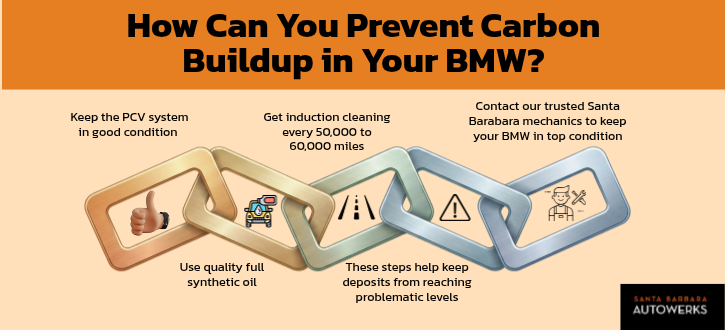
Preventing Carbon Buildup
While no method completely prevents carbon accumulation on direct injection engines, maintaining the PCV system in good condition, using quality full synthetic oil, and performing regular induction cleaning services (typically every 50,000 to 60,000 miles) keeps deposits from reaching problematic levels. Our team of trusted mechanics in Santa Barabara is here to help you keep your BMW in top condition. Contact us today.
Address: 515 Fig Ave, Santa Barbara, CA 93101
Phone: (805) 966-3200
Website: sbautowerks.com
Frequently Asked Questions
Q: How do I know if my BMW needs carbon cleaning?
A: Common indicators include rough cold starts, a slight hesitation or stumble during warm-up, reduced power compared to when the vehicle was new, and in some cases, cold-start misfire codes. If your BMW has over 60,000 miles and has never had carbon cleaning, it is likely overdue.
Q: How long does walnut blasting take on a BMW?
A: The walnut blasting procedure at Santa Barbara Autowerks typically takes three to five hours, including intake manifold removal, cleaning, and reassembly. We perform the service efficiently to minimize your time without the vehicle.
Q: Will carbon cleaning improve my BMW’s fuel economy and power?
A: Most customers notice improved cold-start smoothness, better throttle response, and in many cases, measurable improvement in fuel efficiency after carbon cleaning. The degree of improvement depends on how severe the deposits were before the service.
Q: Does BMW recommend intake valve carbon cleaning?
A: BMW has acknowledged carbon buildup as a maintenance consideration for direct injection engines and has issued updated PCV components to reduce oil vapor ingestion on some models. While not always explicitly listed as a scheduled service, carbon cleaning is widely recognized as a necessary maintenance item for these engines.