



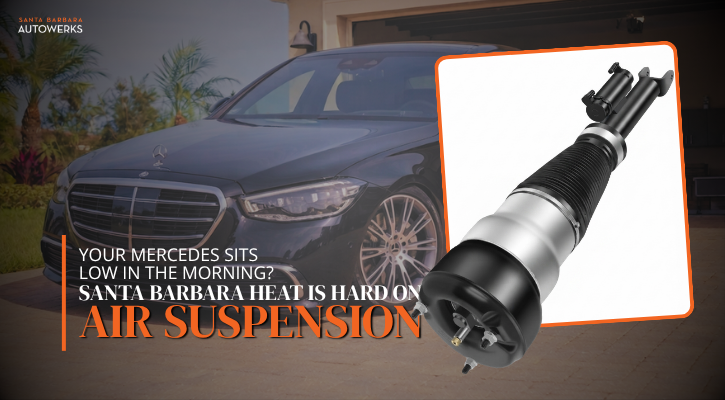
Your Mercedes Sits Low in the Morning? Santa Barbara Heat Is Hard on Air Suspension
31 Jul, 26
You walk out to the S-Class parked off Anacapa Street. It’s crouched in the driveway, one corner lower than the rest. Start it, wait a minute, and it slowly lifts back to ride height. That sag is your Mercedes air suspension talking, and summer only makes it worse.
AIRMATIC systems run on air struts, a compressor, and rubber bladders that all age faster in heat. A July climb up San Marcos Pass on Highway 154, with the compressor cycling nonstop to hold the car level, is exactly when a tired system finally quits. Caught your Mercedes riding low this summer? Don’t wait on it.
Quick Summary: Key Takeaways
- The morning sag is the first clue: A Mercedes that sits low overnight and lifts slowly is leaking air somewhere in the AIRMATIC system.
- Heat ages the rubber: Air struts and bladders dry out and crack faster in summer, so the compressor works harder to keep up.
- A leak kills the compressor: Left alone, one weeping strut runs the compressor to death, turning a $700 strut into a repair past $1,500.
- Don’t drive it bottomed out: Riding on a collapsed strut damages the shock and the parts around it.
- We diagnose with factory tools: Star-level scans pinpoint the leaking corner instead of guessing.
How Mercedes Air Suspension Fails as the Temperature Climbs
Air suspension fails in heat for one simple reason. The system is mostly rubber and seals. Each air strut uses a flexible bladder that flexes thousands of times on every drive, and years of UV, engine-bay heat, and hard cycles leave that rubber checked, brittle, and ready to split at the worst possible moment. Then it leaks.
The compressor pays for that leak. Every time a strut bleeds off air, the little pump kicks on to refill it. Do that on a 90-degree day, over and over, and the compressor overheats and wears out years before it should. A system that held all winter starts sagging in July.
The Symptoms Santa Barbara Drivers Notice First
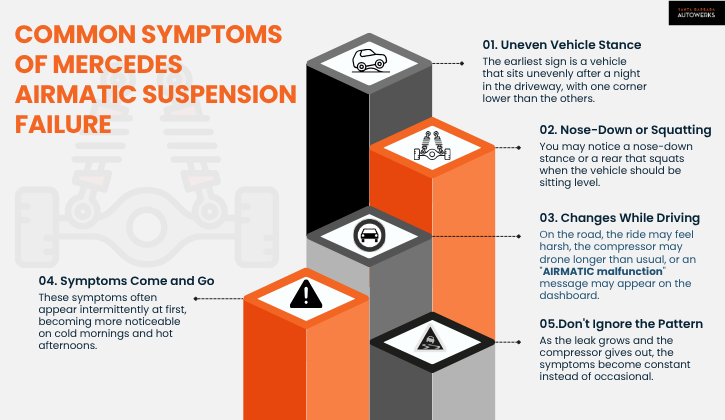
The earliest sign is a car that sits unevenly after a night in the driveway. One corner low. A nose-down stance. A rear that squats when it should sit level. On the road you might feel a harsh ride, hear the compressor droning longer than usual, or catch an “AIRMATIC malfunction” message on the dash.
Watch the timing. These symptoms come and go at first, worse on cold mornings and hot afternoons, and then they turn constant as the leak grows and the compressor gives out. Don’t ignore that pattern.
Why the 154 and the 101 Expose a Weak System
Load and heat are what break a marginal air suspension. Few things load it like a summer grade. Climb the 154 toward Los Padres, or crawl the 101 to Ventura in Friday traffic, and the compressor works overtime holding the car level while under-hood temperatures peak at the same moment. A system that’s 90 percent healthy limps around town in May and quits on a hot highway run in August.
Towing makes it worse. A loaded car does too. The more weight the struts carry, the harder the compressor cycles, and the faster a hairline leak becomes a dead corner.

Why You Don’t Keep Driving a Sagging Mercedes
A collapsed strut isn’t just uncomfortable. It gets expensive fast. Ride on a bottomed-out corner, and you can wreck the strut, the air line, and the shock inside it, and a compressor left chasing a big leak overheats and dies right along with them. Now you’re buying two parts instead of one.
The math is simple. A single strut caught early runs a few hundred to around $900 installed. Ignore it, and a compressor plus multiple struts can climb past $2,500. Summer is hard on cars, and AAA expected to rescue 7.7 million drivers this summer, so a small fix now beats a roadside failure later.
How We Diagnose and Repair Air Suspension the Right Way
We start with a factory-level Mercedes scan and a hands-on leak check. No guessing. That tells us whether you’re losing air at a strut, a line, the valve block, or the compressor, and from there we replace only the part that actually failed and confirm the system holds pressure and levels on all four corners.
Most air suspension jobs go out the same day or the next. Qualifying repairs carry our 2-year/24,000-mile warranty. You deal with German-car specialists who work on AIRMATIC every week.
Frequently Asked Questions
Q: Why does my Mercedes sit low overnight in the summer?
A: An overnight sag almost always means an air strut or line is leaking. Heat dries and cracks the rubber bladders, so the affected corner slowly bleeds down while the car sits. It usually lifts back up once the compressor runs, which is really the system masking a leak that will only get worse.
Q: Is it safe to drive a Mercedes with failing air suspension?
A: For short, low-speed trips, maybe. But you’re risking bigger damage. Driving on a collapsed strut can ruin the shock and burn out the compressor. If a corner is fully down or you see an AIRMATIC warning, get it in before your next highway drive.
Q: How long does an AIRMATIC repair take?
A: Most air suspension repairs are done the same day or the next, depending on the part and availability. We give you a firm timeline right after the diagnostic scan and leak test.
Get Your Mercedes Checked Before the Next Hot Drive
Noticed your Mercedes sitting low or throwing an AIRMATIC warning? Bring it in before summer heat finishes off the compressor.
Santa Barbara Autowerks, Inc. — 515 Fig Avenue, Santa Barbara, CA 93101
Hours: Monday–Friday, 8:00 AM – 5:00 PM (closed weekends)
Website: sbautowerks.com