



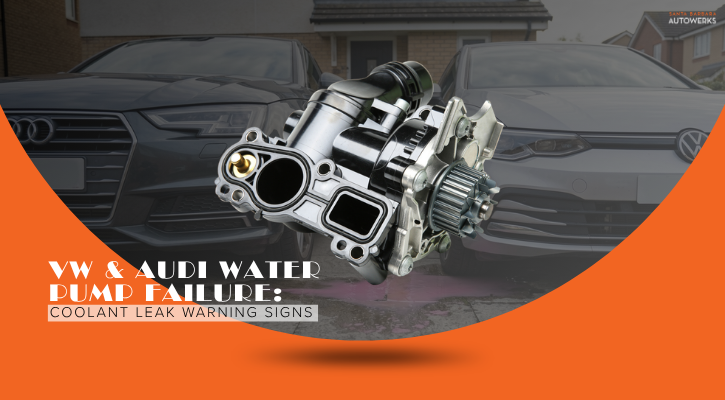
VW & Audi Water Pump Failure: Coolant Leak Warning Signs
20 Aug, 26
Pink crust on the front of the engine. Low coolant message a month after you topped it off. Heat gauge creeping up on the grade heading out of Santa Barbara toward the pass, then settling once you level off, which is the moment most owners finally call a shop.
Water pumps on modern Volkswagen and Audi engines are plastic modules, not the cast iron units your father replaced. They fail quietly, and they take the thermostat with them.
Quick Summary: Key Takeaways
- Look for residue: dried coolant leaves a pink or violet crust at the pump housing seam long before a puddle appears.
- Plastic housings crack: the 2.0T EA888 combines pump and thermostat in one plastic module, and the seam weeps with age and heat cycling.
- Replace as a set: a pump job should include the thermostat, the O-rings and fresh coolant, because going back in twice doubles the labor.
- Coolant spec matters: these engines want the correct violet G13 or G12 series coolant, never a universal green jug from a big box store.
- Overheating ends engines: a warped head or a failed head gasket costs several times what a pump module job costs.
A leaking water pump shows itself before it strands you
Coolant leaves evidence. Look for a chalky pink or violet crust where the pump housing meets the block, a faint sweet smell after a drive, and a coolant level that keeps dropping without a puddle under the car.
Belly pans hide the drip. On an A4 or a Tiguan the underbody tray catches coolant and lets it evaporate, so the level warning arrives before you ever see a stain on the driveway. Watch the gauge on hills. A pump that can’t move coolant at low rpm shows up first as heat that climbs while you climb.
The plastic pump and thermostat module is the failure point
Modern German engines package the pump and thermostat together. On the 2.0T EA888 that module bolts to the block in plastic, and the housing seam or the shaft seal starts weeping somewhere between 60,000 and 100,000 miles.
Age beats mileage here. A garage-kept Audi with 55,000 miles and twelve years on the clock is as likely to leak as a commuter car with 90,000, because heat cycles and old plastic do the damage rather than distance. The 3.0 supercharged V6 has its own version of this problem in its thermostat housing.
German cooling systems are strict about specification
These cars are picky, and for good reason. The wrong coolant reacts with aluminum and seals, gels in the heater core, and turns a routine service into a flush and a new expansion tank.
That sensitivity isn’t unique to coolant, since the federal fuel economy site notes that simply using the wrong grade of motor oil costs 1 to 2 percent in gas mileage, and a coolant that ignores Volkswagen’s G13 or G12 series spec does far worse than that inside the engine. Read the label. Then read the service manual.
Ignoring a small coolant leak risks the whole engine
Aluminum heads don’t forgive overheating. Run one hot on the 101 in traffic and you can warp a head, cook a head gasket, or crack a plastic thermostat housing that then dumps every drop of coolant in about a mile.
Do the math. Replacing a pump and thermostat module costs a fraction of what a head gasket job costs, and the leak you fix in August is the tow you avoid on a Thanksgiving trip up the coast. We’d rather do the small job.
Our repair includes a pressure test and the right coolant
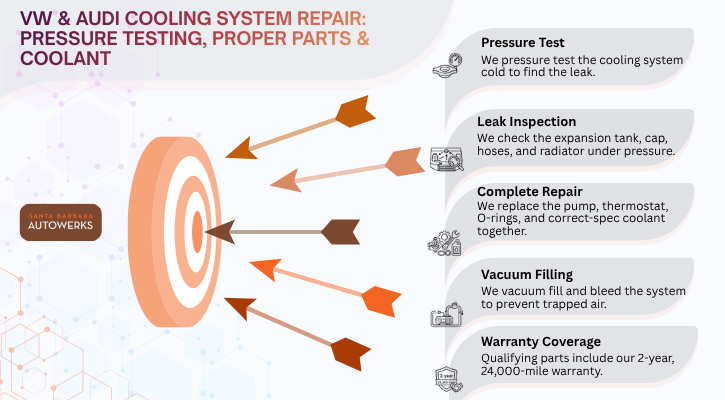
Finding the source comes first. We pressure test the cooling system cold, look for the leak under pressure with the belly pan off, and check the expansion tank, the cap, the hoses and the radiator before we condemn the pump.
Then the job gets done properly. Pump, thermostat, O-rings and correct-spec coolant go in together, the system gets vacuum filled and bled so no air pocket fools the temperature sensor, and qualifying parts carry our 2 year, 24,000 mile warranty.
Santa Barbara owners get a German-only shop on Fig Avenue
German cars are all we work on. No exceptions. Audi, BMW, Mercedes, MINI and Volkswagen come through every day, which means the tech pulling your intake has done that exact module before and knows which bolt likes to seize.
We’re on Fig Avenue near downtown, a couple of minutes off the 101, and drivers come from Goleta, Montecito and Ventura. Peter has built the shop on straight answers. Ask what can wait and you’ll get an honest one.
Frequently Asked Questions
Q: What are the signs of a failing water pump on a VW or Audi?
A: Watch for a low coolant warning that returns, pink or violet crust at the pump housing, a sweet smell after driving, temperature that climbs on hills, and sometimes a whine from the front of the engine.
Q: How long does a VW water pump last?
A: Most plastic pump and thermostat modules start weeping between 60,000 and 100,000 miles, though age matters as much as mileage. Twelve-year-old plastic leaks whether the car was driven or parked.
Q: Can you drive with a small coolant leak?
A: Not far. A slow seep can become a sudden loss when a plastic housing cracks, and one overheating episode on an aluminum engine can cost a head gasket or worse.
Q: What coolant does an Audi or Volkswagen need?
A: The violet G13 or G12 series coolant the manufacturer specifies for that engine and year. Universal green coolant is not a substitute, and mixing types can gel and clog the heater core.
Have the coolant leak found before it overheats
Book a visit and we’ll pressure test the system, show you the source, and quote the pump and thermostat together. Use the appointments page to reserve a morning.
Santa Barbara Autowerks, Inc. — 515 Fig Avenue, Santa Barbara, CA 93101
Hours: Mon-Fri 8:00 AM-5:30 PM; Sat-Sun closed
Website: sbautowerks.com