



Santa Barbara Brake Dust Is Etching Your BMW’s Wheel Finish
28 Nov, 26
Most owners treat brake dust as a washing problem. It is a chemistry problem. The gray film on a BMW’s front wheels is mostly iron particles shed by the pad and the rotor, thrown off hot, and they embed in the clear coat instead of resting on it. Add the salt and moisture that coastal air carries everywhere near the water in Santa Barbara, and those particles corrode in place. Leave it long enough and no amount of washing brings the finish back, because the damage is under the surface.
Quick Summary: Key Takeaways
- The dust is iron: it is not soot, and it bonds to clear coat while it is still hot.
- Coastal moisture accelerates it: salt air keeps the particles damp, which is what lets them rust into the finish.
- Low-dust pads are a real option: they involve a genuine trade in bite and rotor wear.
- Washing weekly beats any coating: a sealant laid over wheels you never clean does nothing.
- Pitting is permanent: once the clear coat is breached, refinishing is the only fix.
The chemistry of what lands on your wheel
Friction material transfers to the rotor every time you brake, and the pad and the rotor both give up material in the process. On a dynamometer, the California Air Resources Board measured six light-duty vehicles and put brake wear particulate at between 3.3 and 13.6 milligrams per mile at the vehicle level.
Pad compound moves a car within a spread like that, and European compounds are chosen for cold bite and consistent pedal feel instead of for staying clean. The front wheels collect the larger share, because the front brakes do most of the stopping, and because the wheel sits a few inches behind the caliper doing the work.
The pad decision and what it costs you
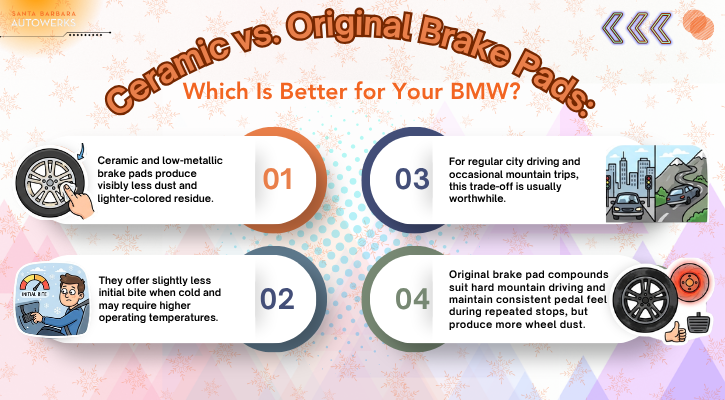
Ceramic and low-metallic compounds produce visibly less dust and lighter-colored dust that does not stain. They also tend to have slightly less initial bite when cold and, on some applications, a higher operating temperature before they come fully alive.
For a car that drives the 101, Santa Barbara streets and the occasional run up the pass, that trade is usually worth taking. For an owner who drives hard on mountain roads and wants the pedal to feel the same on the twentieth stop as the first, the original compound is the better answer and the wheels are the price.
There is a third factor nobody mentions at the counter. Cheap pads from unknown suppliers often dust heavily and unevenly, and the dust is coarser. A good mid-range pad from a recognized manufacturer is frequently cleaner than a bargain one, so the cheapest line on the estimate is not always the cheapest outcome for the wheels.
Keeping the finish you have
The barrel of the wheel, the part you cannot see without turning the steering to full lock, usually looks far worse than the face. It also matters less cosmetically and more mechanically, because that is where dust packs into the valve stem area and around the wheel weights.
Wash the wheels weekly with a pH-neutral wheel cleaner and a soft brush that reaches behind the spokes. Weekly matters more than the product. Two weeks of baked-on dust takes an acidic cleaner to shift, and acidic cleaners attack the clear coat you are trying to protect.
Iron-removing cleaners, the ones that turn purple as they work, are the correct tool for dust that has been sitting. Use them occasionally, not every wash. A sealant or ceramic coating on a clean wheel genuinely helps, because it gives the particles a sacrificial layer to embed into instead of the clear coat.
When the wheel is already pitted
Run a fingernail across the face of the wheel. Smooth means the dust is sitting on top and a proper cleaning will recover it. A fine roughness, like very light sandpaper, means the particles have broken through and started corroding into the aluminum underneath.
At that point you are choosing between living with it and having the wheel refinished. Refinishing is a cosmetic job and not a mechanical one. Do it before the corrosion reaches the bead seat, because a pitted bead seat will not hold air reliably.
Owners in Goleta and Montecito bring us wheels in the same condition, and the marine air on the drive in is the common factor.
One More Reason to Look at the Wheels
Pulling the wheels to clean them properly is also the only time most people see their own brakes. Pad thickness, rotor lip, the condition of the caliper slide boots: all of it is visible once the wheel is off and invisible while it is on. If you are not going to do that yourself, have a shop do it once a year.
Santa Barbara Autowerks, 515 Fig Avenue, Santa Barbara, CA 93101. More at sbautowerks.com.