



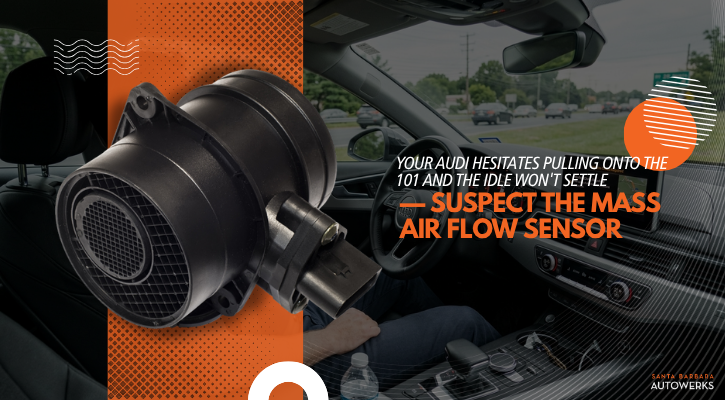
Your Audi Hesitates Pulling Onto the 101 and the Idle Won’t Settle — Suspect the Mass Air Flow Sensor
22 Sep, 26
Merging at Carrillo takes more pedal than it used to. The idle hunts a little at the light, there is a flat spot around 2,000 rpm, and the check engine light came on quietly last week without anything dramatic happening.
On a German engine that combination usually means the mass air flow sensor. Audi, BMW, Mercedes and Volkswagen engines meter fuel from what the MAF reports, so a sensor reading twelve percent low makes the whole car feel lazy without ever failing outright. Santa Barbara‘s dust and its damp mornings are hard on the element, and a lit dash also means an automatic Smog Check failure.
Quick Summary: Key Takeaways
- The MAF sets the fueling: Injector timing is calculated from measured airflow, so a low reading means a lean mixture.
- It drifts before it dies: A tired sensor reads wrong for months without ever failing outright.
- Intake leaks fake the same codes: Unmetered air after the sensor sets identical faults, so the plumbing gets checked first.
- Cleaning is maintenance, not a repair: A drifted hot-wire element does not come back.
- A lit light fails Smog Check: California rejects a vehicle with the check engine light on, regardless of what the tailpipe would have done.
What the Mass Air Flow Sensor Measures and Why Small Errors Matter
The sensor sits between the air filter and the throttle body. It heats a tiny wire or film, then measures how much current it takes to hold that element at temperature while intake air rushes past and tries to cool it down.
That number becomes the fueling calculation. The computer takes measured airflow, applies the target air-fuel ratio, and decides how long to hold each injector open. Read ten percent low and you run ten percent lean.
Lean is not harmless. You feel it as hesitation and you pay for it in misfire counts, and over enough months the long-term fuel trims stretch so far trying to compensate that the computer runs out of correction range and finally sets a code. By then the converter has been working overtime too.
The Symptoms Show Up Long Before a Hard Failure
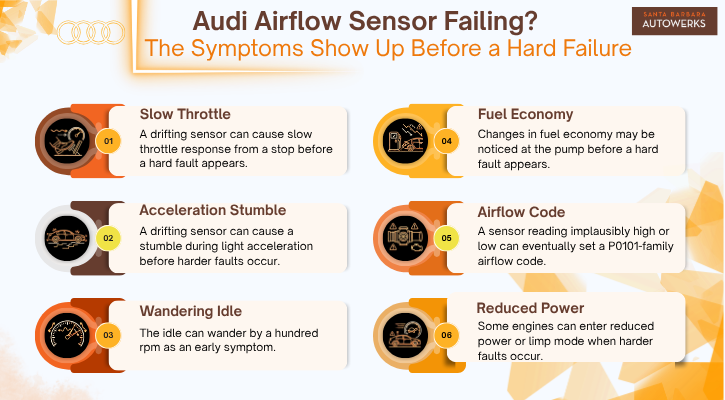
Drifting sensors produce vague complaints, which is why they get ignored. Slow throttle response from a stop. A stumble on light acceleration. An idle that wanders a hundred rpm, and fuel economy you notice at the pump rather than on the dash.
Then there are the harder faults. A sensor reading implausibly high or low sets a P0101-family airflow code, and some engines drop into reduced power to protect themselves. Limp mode, in other words.
The clean tell is the unplug test. Pull the sensor connector. If the car runs noticeably better, the sensor was lying, because the computer falls back to a calculated value the moment the signal disappears.
Intake Leaks and Dirty Filters Produce the Same Codes
Never buy a MAF sensor off a code alone. Air that sneaks in downstream of the sensor never gets counted, and the computer reacts exactly as though the sensor were under-reporting.
The usual suspects are cracked plastic intake tubes, a split boot at the throttle body, a clamp left loose after somebody changed an air filter, and on turbocharged Audi and Volkswagen engines a perished PCV diaphragm that has been pulling unmetered air for months.
Filters matter more here than most places. Dust off the foothills and grit carried down by the sundowner winds load a filter fast, and a restricted filter changes what the sensor sees.
How We Confirm a Sensor Before Anyone Buys One
Live data does the work. We read grams-per-second airflow at idle and at wide-open throttle, then compare it against what the engine’s displacement should be pulling. A healthy sensor tracks that closely.
Then we read the fuel trims. Positive at idle and near normal at cruise points at a vacuum leak. Positive everywhere points at metering. That one distinction decides the repair.
On a BMW N20 or N55 we also cross-check reported airflow against the boost pressure the same computer is publishing, because two sensors disagreeing narrows the search fast. A smoke test finishes it. Filling the intake with low-pressure smoke shows any leak in seconds, and it is a great deal cheaper than a sensor you did not need.
A Lit Check Engine Light Is an Automatic Smog Check Failure
California does not negotiate on this. The Bureau of Automotive Repair states plainly that a vehicle will not pass a Smog Check with the check engine light on, and that a Smog Check is required every other year to renew registration.
Clearing the code does not solve it either, because the inspection also checks that the car’s self-tests have completed. Erase the fault and you buy yourself a drive cycle instead of a sticker.
So fix the cause, verify the trims come back to normal, then go. That order saves a second trip.
Santa Barbara Owners Get German-Only Attention on Fig Avenue
We work on Audi, BMW, Mercedes, MINI Cooper and Volkswagen. Nothing else. That narrow focus is why a fuel-trim conversation here starts with the specific engine family rather than a generic checklist.
The shop is at 515 Fig Avenue, a few blocks off the 101 downtown, with ASE-certified technicians and a 2-year, 24,000-mile warranty on qualifying parts.
Drivers come to us from Goleta, Montecito and Ventura. If the car feels lazy and the light is on, bring it in before your registration comes due.
Frequently Asked Questions
Q: What are the symptoms of a bad mass air flow sensor?
A: Hesitation, a hunting idle, a flat spot in the mid range, worse fuel economy, and usually a check engine light with an airflow or lean code. Most sensors drift gradually, so the car feels duller rather than broken.
Q: Can you clean a MAF sensor instead of replacing it?
A: Cleaning with a proper MAF-specific spray is worth trying and sometimes restores accuracy on a merely dirty sensor. It will not fix an element that has physically drifted or a damaged sensor housing, and never touch the wire itself with anything solid.
Q: Will a bad MAF sensor fail a California Smog Check?
A: If it has turned on the check engine light, yes, automatically. The inspection rejects any vehicle with the malfunction indicator lamp illuminated. Even without a lit light, a badly skewed sensor can push emissions readings out of range.
Q: How can I tell a MAF problem from a vacuum leak?
A: Compare fuel trims across the rev range. A vacuum leak shows a large positive correction at idle that shrinks at cruise, because the leak matters less when a lot of air is flowing. A metering error stays positive everywhere. A smoke test confirms it.
Get the Airflow Reading Verified Before You Buy a Sensor
A MAF sensor is not a cheap guess on a German engine. Book a diagnostic visit and we will read live airflow, check the fuel trims, smoke-test the intake and tell you exactly which part is lying to your engine.
Santa Barbara Autowerks — 515 Fig Avenue, Santa Barbara, CA 93101
Hours: Mon-Fri 8:00 AM-5:30 PM; Sat-Sun closed
Website: sbautowerks.com